RBP020L062V Financial Performance Management Summative Assessment 2026
Structure and presentation (RBP020L062V Summative Assessment)
The assignment should address the following questions:
QUESTION 1 (30%):
Select an international organization (of your choice – company A) and identify its closest competitor (company B). Present the two organizations and the criteria used for the identification of the competitor. Use the ratio analysis technique to evaluate the financial performance of the two organizations; draw a comparative evaluation and critically discuss the findings. You need to access the annual financial statements of at least the last two years and provide details of the ratio calculations.
QUESTION 2 (30%):
With reference to relevant literature, critically evaluate Kaplan and Norton’s Balanced Scorecard as a Strategic Management System. Develop a proposed Balanced Scorecard to include critical success factors (CSF’s) for your selected organisation (company A).
QUESTION 3 (30%):
Provide a critical analysis of the benefits and challenges of adopting Integrated Reporting (IR) for your selected organization (company A). Use academic literature and refer to the International Integrated Reporting framework to support your discussion.
PRESENTATION (10%):
Mark awarded for presentation refers to overall structure and presentation, academic style of writing.
Note: Please refrain from selecting companies that have been shown for demonstration purposes during the sessions (this includes, for example, Coca-Cola, Pepsi, Tesco, and Sainsbury). Also, the report should not choose banks because they have very different financial statement formats.
Struggling with RBP020L062V Financial Performance Management Assessment at URL?
Native Singapore Writers Team
- 100% Plagiarism-Free Essay
- Highest Satisfaction Rate
- Free Revision
- On-Time Delivery
IMPORTANT GUIDANCE
Good answers should cover the following:
Checklist for Q1 (recommendations for a good answer, but not limited to):
– Describe the chosen company and its competitor.
– The selection of the competitor should be based on operating activities and financial information because the competitor needs to be of comparable size with the chosen company.
– Give general information and some financial information such as sales, assets, and overall profitability for the chosen company and its competitor. This financial information should be used to justify competitor selection in addition to operating activities in the same industry and country.
– Cover a broad range of ratio analysis, including liquidity, working capital cycle, profitability, leverage, and valuation ratios.
– Explain and interpret in more details some ratios in each category.
– Compare ratios over the years and with the competitor.
– Connect different ratios together and draw a big picture of companies’ financial performance
– Show input data, calculations of ratios either in the body or in the appendix.
– Use graphs and tables to present your analysis.
– Cite relevant literature both in-text and in reference list
Checklist for Q2 (recommendations for a good answer, but not limited to):
– Critically evaluate Kaplan and Norton’s Balanced Scorecard (BSC).
– Critically discuss why the traditional BSC could be out of date in recent years and what could be improved.
– Develop a balanced scorecard for the chosen company.
– It is important to discuss the company’s strategy and vision, which is the foundation for the objectives of each dimension of BSC.
– Explain goals (objectives) and measures of the BSC
– Answer must be based on the chosen company
– Cite relevant literature both in-text and in reference list
Checklist for Q3 (recommendations for a good answer, but not limited to):
– Show an understanding of the benefits and challenges of adopting integrated reporting at the chosen company. For example,
o Critically discuss how IR provides investors with financial-historical information, and non-financial and forward-looking information, thus overcoming the limitations of a traditional set of financial statements
o Critically discuss what information can be obtained from IR reports and how they helps investors to understand companies’ use of limited resources for long-term sustainable success and to balance different interests of various stakeholders
– Answer must be based on the chosen company
– Cite relevant literature both in-text and in reference list
Checklist for presentation (recommendations for a good answer, but not limited to):
– Appendix for input data for calculations (if not included in the body)
– Appendix for extracts of balance sheets and income statements used for analysis, or links to websites
– Harvard style for references and in text citations
– Headlines for sections and subsections
– A balanced structure report (e.g. around 1000 words for each question)
– Comprehensive range of relevant (academic and professional) sources
– Appropriate report structure (see the proposed structure below)
– Within the word limit of 3,500 words +/- 10%, excluding references, tables, figures, and appendix
Any written work should be spell-checked and a contents page should be included. Do not use various font sizes and colours; Black ink, Arial, size 11, 1.5 lines spaced is recommended. Use DIN A4 format and page margins of 2.5 cm or 1 inch.
PROPOSED STRUCTURE OF THE REPORT:
1. Introduction
Introduce the scope and focus of the report (approx. 250 words)
2. Financial Performance using Ratio Analysis
Question 1 (approx. 1,000 words)
3. Balanced Scorecard
Question 2 (approx. 1,000 words)
4. Integrated Reporting
Question 3 (approx. 1,000 words)
5. Conclusions
Provide an overall conclusion based on the reflection from the report (approx. 250 words)
References
Appendix – Provide details on the calculations presented in Question 1.
The proposed structure above intends to provide a recommendation on the structure of the coursework. This can be enriched with more sections/subsections as you consider appropriate (example abstract, executive summary, table of contents, appendices, etc.).
Full reading list
There will be weekly guided readings and you will be expected to undertake your own review of relevant literature, both academic and professional. Refer to Moodle for guidance on weekly readings.
Essential Readings
Atrill, P., McLaney, E.J. (2018). Management Accounting for Decision Makers. Pearson.
Berk, J., DeMarzo, P. (2017). Corporate Finance (3rd ed.), Chapter 2. Pearson. Busco, C., Malafronte, I., Pereira, J., Starita, M. (2019). The Determinants of Companies’ Levels of Integration: Does One Size Fit All? The British Accounting Review, 51(3), 277-298. IIRC (2013). International Integrated Reporting Council. (2013). International framework. Available at http://integratedreporting.org Malafronte, I., Pereira, J., Busco, C. (2020). The role of corporate culture in the choice of integrated reporting. CIMA Research Executive Summary, 16(2). Available at https://www.cimaglobal.com Kaplan, R.S. (2010). Conceptual foundations of the balanced scorecard. Working Paper 10-074.
Further Readings (more readings will be provided on Moodle) Barth, M. E., Cahan, S. F., Chen, L., Venter, E. R. (2017). The economic consequences associated with integrated report quality: Capital market and real effects. Accounting, Organizations and Society, 62, 43-64. Busco, C., Quattrone, P. (2015). Exploring how the balanced scorecard engages and unfolds: Articulating the visual power of accounting inscriptions. Contemporary Accounting Research, 32(3), 1236-1262. Busco, C., Frigo, M.L., Quattrone, P., Riccaboni, A. (2013). Integrated Reporting: Concepts and Cases that Redefine Corporate Accountability. Springer. Busco, C., Frigo, M. L., Quattrone, P., Riccaboni, A. (2013). Redefining corporate accountability through integrated reporting. Strategic Finance, 8, 33-41. Busco, C., Granà, F., Quattrone, P. (2017). Integrated thinking. CIMA Research Executive Summary, 13(3), 1-26. Cardinaels, E., van Veen-Dirks, P. (2010). Financial versus non-financial information: the impact of information organization and presentation in a balanced scorecard. Accounting, Organizations and Society, 10(6), 568–578. De Villiers, C., Rinaldi, L., Unerman, J. (2014). Integrated Reporting: Insights, gaps and an agenda for future research. Accounting, Auditing & Accountability Journal, 27(7), 1042-1067. Dumay, J., Bernardi, C., Guthrie, J., Demartini, P. (2016). Integrated reporting: A structured literature review. Accounting Forum, 40(3), 166-185. Garcia-Sanchez, I.M., Raimo, N. Vitolla, F. (2020). CEO power and integrated reporting. Meditari Accountancy Research. Greatbanks, R. Tapp, D. (2007). The impact of BSC in a public sector environment: Empirical evidence from Dunedin City Council New Zealand. International Journal of Operations and Production Management, 27(8), 846–873.
Hoque, Z. (2014). 20 years of studies on the balanced scorecard: Trends, accomplishments, gaps and opportunities for future research. British Accounting Review, 46(1) pp. 33–59.
Malafronte, I., Pereira, J. (2020). Integrated thinking: measuring the unobservable. Meditari Accountancy Research.
Kaplan, R.S., Norton, D.P. (2007). Using the balanced scorecard as a strategic management System. Harvard Business Review. July/August.
Nørreklit, H., Mitchell, F. (2014). Contemporary issues on the balance scorecard. Journal of Accounting & Organizational Change, 10(4).
Salterio, S.E. (2012). Balancing the scorecard through academic accounting research: opportunity lost? Journal of Accounting and Organizational Change, 8(4), 458–476.
How will your work be assessed?
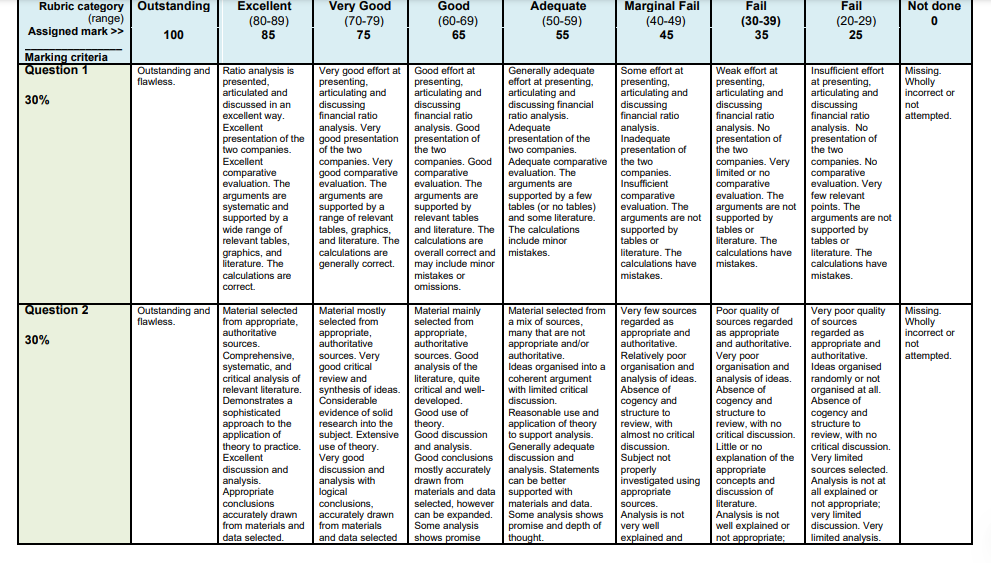
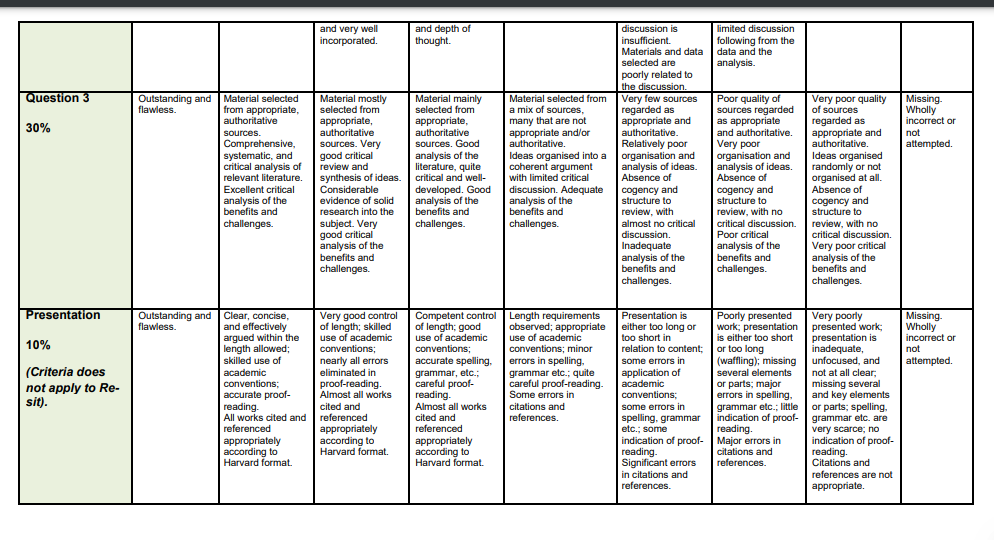
Your work will be assessed by a subject expert who will use the marking criteria provided in the section “Instructions for assessment” and the Marking rubric enclosed in the Appendix for this module. When you access your marked work it is important that you reflect on the feedback so that you can use it to improve future assignments.
Referencing and submission
You must use the Harvard System.
The Business School requires a digital version of all assignment submissions. These must be submitted via Turnitin on the module’s Moodle site. They must be submitted as a Word file (not as a pdf) and must not include scanned in text or text boxes. They must be submitted by the given date. For further general details on coursework preparation refer to the online information at Student Portal and Moodle.
Mitigating circumstances/what to do if you cannot submit a piece of work or attend your presentation
The University Mitigating Circumstances Policy can be found on the University website:
Mitigating Circumstances Policy
Marking and feedback process
Between you handing in your work and then receiving your feedback and marks, there are a number of quality assurance processes that we go through to ensure that students receive marks which reflects their work. A brief summary is provided below.
• Step One – The module and marking team meet to agree standards, expectations and how feedback will be provided.
• Step Two – A subject expert will mark your work using the criteria provided in the assessment brief.
• Step Three – A moderation meeting takes place where all members of the teaching and marking team will review the marking of others to confirm whether they agree with the mark and feedback.
• Step Four – Work then goes to an external examiner who will review a sample of work to confirm that the marking between different staff is consistent and fair.
• Stop Five – Your mark and feedback is processed by the Office and made available to you.
Additional instructions for Re-sit
The same assignment task as for the main assignment period applies to the re-sit. Re-sit deadlines will be published via Moodle. Visit the module’s Moodle site and check your Roehampton email account on a regular basis. The school is not obliged to check whether you have noticed re-sit deadlines.
You are required to improve and resubmit your original work as well as adding a further reflective commentary in the form of a 400-700 words Essay. You must resubmit your work using the specific resit Turnitin link on Moodle. This additional word count can be added on top of the original word count of the assignment, if you used the full word count.
The original marking criteria will still apply (see marking grid in Appendix) except that the 10% weighting for presentation will be awarded instead to your additional Reflective Essay section. That is a statement demonstrating how you learnt from the feedback and what you did differently the second time. Also reflect how the module contents could be beneficial as knowledge of best practices for a future management, public administration or advisory career.
If you did not submit work at the first opportunity, you cannot reflect on your feedback. However, in such case, your Reflection Essay section should reflect upon a) how the module’s concepts are informing the professions and open up areas of future empirical research and b) how the module contents could be beneficial as knowledge of best practices for your future management, public
administration or advisory career.
If you were deferred at the first assessment opportunity you do not need to include the reflective piece as this is a first submission at a later date, not a re-sit.
The Reflective Essay is marked based on the criteria of Criticality and Evidence-based Logic of arguments. It is an independent writing task and no supervision will be provided for conducting the essay.
Get Your RBP020L062V Financial Performance Management Summative Assessment Done Right
The post RBP020L062V Financial Performance Management Summative Assessment 2026 appeared first on Singapore Assignment Help.